Posts

Showing posts with the label Somerset

Taunton, Somerset

Image
Georgian Art Deco Here is something I have little to say about – with the exception of single a observation. This Post Office in Taunton was built in 1911 in the neo-Georgian style (red brick with stone dressings on the upper floors, stone on the ground floor) then popular for Post Offices. I have noticed before how this style was popular in the early-20th century, and seemed to work well. But look at the letterforms used on the identifying 'Post Office' sign above the door. Cut carefully into the stone, the letters look nothing if not Art Deco – those elongated letters popular on shop fronts in the 1920s. I am thinking of the Fs and Es with cross bars near the top of the letter, the enlarged bowl of the P, the slightly forward-sloping S. Is the lettering later than the rest of the building, or unusually forward-looking? I really don't know, but I like the way the two things work together – and how they made me pause and ponder as I walked along the street.

Portishead, Somerset

Image
Where the light is right The small, sturdy metal structure of Black Nore Lighthouse was put up in 1894, to assist shipping in the Severn Estuary. It flashed every ten seconds to guide countless vessels towards and away from the harbour at Bristol, until it was taken out of service in 2010. It originally had a clockwork drive mechanism and this was only replaced with electric motors in the year 2000. Although this light is no longer needed, there’s another not far away at Battery Point, which still guides ships. Fortunately, the lighthouse has been preserved (it now belongs to a trust that looks after it), so I could find it the other day when I was in Portishead to give a talk and arrived – as is my wont – much too early. I’m a great advocate of arriving early for meetings and talks, as it usually gives me the opportunity to have a look round somewhere and, as often as not, find some interesting bit of architecture or structure. I especially like the metal cross rods, attached with scr...

Bridgwater, Somerset

Image
About time The other day someone asked me if I was on Instagram. I had to admit that I was not. I’d tried Twitter and thought about Instagram, but blogging seemed to be the platform for me. But the question suggested to me that perhaps it was about time I was on Instagram, and prompted me to have another go. I now have an Instagram account, @philipbuildings . It will not be a torrent of images, but my initial plan is to post more often than I blog, and offer a selection of things I’ve seen, mostly but not exclusively architectural. I’ll probably include more pictures of places and buildings near where I live – I have done blog posts about quite a few local buildings over the years, but as my blog is called English Buildings , I try not to have to much of a local bias. This is not meant to replace blogging for me. For now at least, I intend to carry on here in my usual way. But do have a look at my Instagram and feel free to follow, like, and share. The clock in the picture, by the way,...

Martock, Somerset

Image
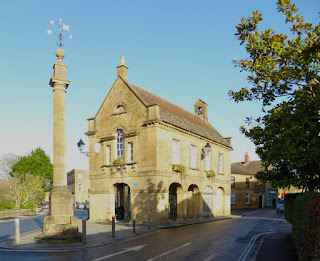
Well provided for I always think of the Tudor and Stuart periods as the great age of English market houses, which are so often built in a kind of rustic classicism that suggests local pride and modest prosperity. The one at Chipping Campden is a favourite, Abingdon another, on a far grander scale and far from rustic. The stone town of Martock, however, has a mid-18th century one. It’s quietly classical, with elliptical arches and piers that don’t have capitals but just a continuation of the stringcourse that runs around the building to show where the arch begins. Up above there are sash windows and, at the end, a Venetian window above a row of scroll brackets, and above that a blind niche in the form of a semicircle that, when you look at it closely, turns out to be a vent.  It’s very simple, a local builder’s assemblage of basic ingredients, but a satisfying enough recipe for a small country town. Next to it is a structure known as the Market Cross or the Pinnacle. It’s a tall T...

Burford, Oxfordshire, and beyond

Image
Retrospective (2): A handful of fragments As my next short sequence of backward-glancing links to celebrate ten years of blogging , I'm concentrating on fragments – those broken bits and pieces that can tell us so much about history – or occasionally fox us – while also being so evocative. Whether it's bits of medieval stained glass or chunks of old masonry, such unregarded scraps have often surfaced on the English Buildings blog over the last ten years. Here are a few you may have missed... Tantalising bits of stained glass in Oxfordshire Old bits of pottery put to architectural use in Northamptonshire Traces of a mason's yard in Shrewsbury A revealing broken pinnacle in Somerset A whole wall of fragments in Gloucestershire .