Posts

Showing posts with the label book

Into the light

Image
Adrian Barlow, Kempe: The Life, Art and Legacy of Charles Eamer Kempe Published by Lutterworth Press Most people who visit churches admire the stained glass, but how many of us know more than a smattering about the people who designed and made church windows? Stained glass certainly isn’t my own area of expertise, and like many others, my knowledge is limited mostly to those who are famous for doing something else – people like Edward Burne-Jones or John Piper. Many stained glass artists are shadowy figures, even if we know their names. One figure whose name is familiar (from countless church guidebooks, from Pevsner) but whose life is little known is the Victorian designer and maker of stained glass Charles Eamer Kempe. Adrian Barlow’s new biography is here to put us right. Kempe: The Life, Art and Legacy of Charles Eamer Kempe tackles the life in the opening chapters . Barlow leads us through his subject’s upbringing: the unhappy prep school years of a shy and stammering boy, the ha...

Soft machines for living in

Image
Iain Sinclair, Living with Buildings and Walking with Ghosts   Published by Profile Books in association with Wellcome Collection No sooner had Iain Sinclair, apparently tireless writer about London, walker of mean streets, grubber around in corners, tracer of psychogeographical force-fields, and seer of beauty in dilapidation, said his writerly ‘farewell’ to London*, than he’s at it again: walking and writing about the place in an account, made at the behest of the Wellcome Foundation, to explore the relationship between buildings and health. It’s not just London, though, that Sinclair visits. He’s off to Mexico, up to Scotland, and out to Marseille to visit Le Corbusier’s Unité d’habitation. One almost expects him to reprise some of his visits (made for London Orbital ) to the former asylums around the periphery of the capital, but instead, he looks at the site of the Royal Victoria military hospital, Southampton, with its memories of shell-shock. As the title-page of this book s...

Dorset reperambulated

Image
Michael Hill, John Newman, and Nikolaus Pevsner, The Buildings of England: Dorset Published by Yale University Press Another year, another small clutch of revised volumes in Pevsner’s revered Buildings of England series. I’ve chosen Dorset for review because, although it’s not a county I know intimately, it’s a fascinating part of England and one that has given me a lot of pleasure, from its coast and coastal  towns such as Poole and Lyme Regis to inland places like Blandford Forum. I have therefore used the old 1972 edition of Dorset (in which Pevsner himself wrote about the churches while entrusting the secular buildings to John Newman) quite a bit over the years. Dorset has so much interesting architecture: great houses and historic castles, some terrific churches, and a lovely coast – lovely both scenically and architecturally, from Lyme Regis to Poole. To reflect this richness and like every recent revision in the series, Pevsner’s Dorset has grown considerably (from just o...

Homes for heroines

Image
It’s that time of year again: for a week or so this blog is given over to some reviews of new and recent books – for your friends ’ Christmas stockings, perhaps, or your own... Elisabeth Blanchet and Sonia Zhuravlyova, Prefabs: A Social and Architectural History   Published by Historic England In the late-1940s, Britain had to build more houses than ever. A huge chunk had been taken out of the housing stock by bombing – and there were pre-war slums to clear. The call went up again, as it had after World War I, for ‘homes for heroes’. One solution was the prefab – the prefabricated bungalow, mass produced and able to be quickly erected; a way, it was hoped both of filling the housing need and providing work for factories that had made the fighters or bombers that were, mercifully, no longer required in such numbers. The story of Britain’s postwar prefab has been told before,* but there is room for another book, and especially at this time, when so few prefabs are left and residents ...

Irreplaceable at the Victoria and Albert Museum, London

Image
History and places On Tuesday evening I went to the Victoria and Albert Museum for a dual celebration: to celebrate Historic England’s campaign Irreplaceable and to mark the publication of my new accompanying book, Irreplaceable: A History of England in 100 Places .* The idea of the campaign was to highlight and celebrate one hundred remarkable places that have in some way shaped the history of England. The public were asked to nominate their favourite historic places and a panel of ten expert judges¶ then took the thousands of nominations and reduced them to a list of one hundred, equally allocated over ten different thematic categories, from “Music and Literature” to “Power, Protest and Progress”. The result is a fascinating and diverse list of places, from obvious and internationally famous buildings such as Canterbury Cathedral and Windsor Castle to less well known sites, such as a rainy Jewish cemetery in Falmouth and some allotments in Wiltshire. My job was to write something ab...

Where credit is due

Image
Readings and rereadings (1): Lucia Moholy, A Hundred Years of Photography The chance purchase in a secondhand bookshop recently of three paperbacks form the late 1930s prompted me to think about a woman who, like many in the history of the arts, has been marginalised. She is Lucia Moholy, and among her publications is A Hundred Years of Photography , published by Penguin Books in 1939. Lucia Schulz was born in Prague in 1894. A good linguist (like so many people in that city where it was an advantage to be fluent in both German and Czech), she qualified as a teacher of German and English, before studying philosophy and art history at university in Prague. She then worked as an editor in various publishing houses, including Rowohlt in Berlin, before marrying in 1920 the artist László Moholy-Nagy. He was developing his interest in photography and the couple explored this medium together.  When Moholy-Nagy went to teach at the Bauhaus – first in Weimar then at its new school at Dessau...

About the houses

Image
The fourth of my summer reviews is a work of both social and architectural history that throws revealing light on a subject of great importance. This is the last of my reviews for now – it will be back to my usual, more architectural, posts, soon. John Boughton, Municipal Dreams: The Rise and Fall of Council Housing Published by Verso This is a history of council housing in Britain. It combines architectural, social, and political history, to tell the story of this form of housing from its roots in the late-19th century, its real beginnings in the period after 1900, and its growth and eventual decline. Along the way the book profiles planners and architects who wanted to improve people’s lives by building better housing – and creating better environments for residents, many of whom had had to endure slum accommodation. It addresses the various political views that have had an impact on the story – the groups who have embraced council housing and who have condemned it. It discusses the...

Opening doors

Image
The third of my summer book reviews is a general book on world architecture with a fresh and visual approach. John Zukowsky and Robbie Polley, Architecture Inside + Out: 50 Iconic Buildings In Detail Published by Thames & Hudson When I was a teenager and starting to become interested in architecture, I looked everywhere – bookshops, the local library, other people’s houses – for information about the subject. After a while it became clear that certain buildings – star examples – recurred in many books, and some of these buildings baffled me. Two of the most baffling were Le Corbusier’s pilgrimage chapel of Note Dame du Haut, Ronchamp; another was Erich Mendelsohn’s Einstein Tower, Potsdam. Both of these unusual, curvaceous structures seemed to be puzzles. What, I asked myself, was going on in the Ronchamp chapel’s extraordinary billowing roof? Whatever, apart from the telescope at the top, was inside the Einstein Tower – what did it do ? There were plenty of books that told me abou...

The Brutalist world

Image
The second of my quartet of summer book reviews is a massive work of reference on an architectural style that, having fallen out of favour, now seems to be fashionable again. Oliver Elser et al (eds), SOS Brutalism: A Global Survey Published by Park Books  I’ve been impressed by a number of the recent books that have helped us to look with a more informed eye on the concrete buildings of the 1960s and 1970s and have led to a new appreciation of the architectural style known as Brutalism. One of these books has already been reviewed here; others have got me thinking too. I lived through the period when these buildings went up and was educated in a school designed by one of the most celebrated (and occasionally reviled) architectural practices of the period, but these books have told me more about the period and the interest of its architecture. But I’ve been left uncertain of the wider context, and of the definition. What exactly is Brutalism? Every book seems to have a different p...

The mosque in the spotlight

Image
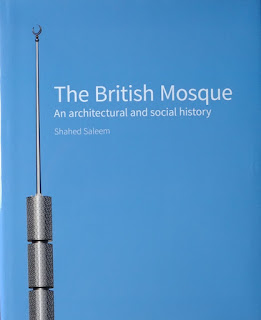
For the next week or so, English Buildings becomes a book blog, and I'll post a handful of recent books that have caught my eye. First, an important addition to the architectural library from Historic England. Shahed Saleem, The British Mosque: An Architectural and Social History Published by Historic England This book is a major contribution to architectural history and to wider cultural understanding. It is the first full-length study of mosque architecture in Britain, and starts with the very beginnings: the first mosques in Britain, such as the outstanding Shah Jahan Mosque in Woking (1889), designed by William Isaac Chambers and complete with onion domes and ogee arches: an early example of a style that would become associated with Islam in England. However, as the book shows, mosques can be much plainer buildings, often adaptations of existing houses or chapels. As the book makes clear at the outset, the main basic architectural requirements for a mosque are few: a prayer hal...

Southwell, Nottinghamshire

Image
The Leaves of Southwell When posting about one of the carvings in the chapter house of Southwell Minster the other week, I inevitably got down from my shelves my copy of The Leaves of Southwell , Nikolaus Pevsner’s short book about this building’s extraordinary late-13th century sculptures of the leaves of plants and trees. I did so to look at the excellent photographs of Southwell’s stone leaves – oak, ivy, maple, buttercup, hop, vine, and other species. I ended up rereading the text of the book as well. The Leaves of Southwell is in the King Penguin series, which are short hardback books published by Penguin Books between 1939 and 1959.* The format for the series consists of an essay (usually of about 30 pages, though Pevsner’s is double that length), followed by a series of illustrations. The photographs, by F L Attenborough, then Principal of University College, Leicester, and father of Richard and David Attenborough, are exemplary: detailed, well printed, and with just the right...

Churches unlocked

Image
William Whyte, Unlocking the Church: The lost secrets of Victorian sacred space Published by Oxford University Press Here’s the last of my Christmas book reviews: an illuminating study of 19th-century church buildings that’s also a good read… William Whyte’s new book offers a revealing way of looking at Victorian churches, one that highlights neither the battle between architectural styles nor the distinction between ‘high’ and ‘low’ church. Whyte instead concentrates on the ways the Victorians understood and experienced church buildings, stressing in particular two key ideas – the church as a symbolic building that can be ‘read’ and the idea that church architecture can shape people’s emotions. Both of these themes are given a new emphasis in the 19th century and they cross theological boundaries: they are expressed by High churchmen and Evangelicals, by Catholics, and even by nonconformists. These ideas are in sharp contrast to those of the Georgian period, in which churches lacked r...

Plans and people

Image
Richard Rogers with Richard Brown, A Place for All People Published by Canongate Books My next pre-Christmas review is an account of life, works, and beliefs by one of our foremost architects... We tend to think of famous architects in terms of their most high-profile projects. Richard Rogers, one of the pre-eminent architects of his generation, brings to mind instantly major buildings like the Pompidou Centre in Paris and the Lloyd’s Building in London. But there is much more to him than that, and this book – part memoir, part architectural inside story, part manifesto – tells the stories not just of these but also of many less well known designs, from his early houses to more recent social housing projects. All these have fascinating aspects, and it’s one of the pleasures of reading this book to discover more about familiar and unfamiliar buildings alike – what drove the designs, the thinking behind them, how they got built. The book is revealing, as one would expect, on the architec...

Buildings of nonconformity

Image
Christopher Wakeling, Chapels of England: Buildings of Protestant nonconformity Published by Historic England The next of my short series of pre-Christmas reviews is of a book that plugs a major gap in English architectural history: a general account of Protestant chapels and meeting houses... The architecture of England’s Protestant churches (from Methodists to Unitarians, Baptists to Quakers) has been a difficult subject to get to grips with. There has been plenty of research (the old Royal Commission on Historic Monuments saw to that) but there is such diversity of denominations and architectural approaches that it is hard to see patterns or get a sense of overall development. In addition, nonconformist churches, unlike so many Anglican churches, are not often open, so casual visitors rarely get inside them. Christopher Wakeling’s new book does much to remedy this situation, giving a clear, wide-ranging, and nuanced account of dissenting architecture in England, from the beginnings ...

Use and ornament

Image
Roger White, Cottages Ornés: The charms of the simple life Published by Yale University Press As the Christmas period approaches, I’m reviewing a small clutch of recent books that I’ve enjoyed and that might give pleasure to readers interested in architecture. First, a book on a kind of house that stands out in landscape and villagescape: the cottage orné … The ornamental cottage – a small rural dwelling made more visually pleasing than the standard worker’s dwelling by means of various decorative embellishments – is one of the most charming phenomena of the 18th and 19th centuries. It has found an enthusiastic and well informed chronicler in Roger White, who begins his survey investigating the roots of the genre in mid-18th century rustic estate buildings before exploring the fashion at the beginning of the 19th century for housing rural workers in picturesque cottages with thatched roofs partly held up with rustic poles, verandahs, bits of timber-framing, fancy bargeboards, and other...

Big house, small details

Image
Holkham: The social, architectural and landscape history of a great English country house by Christine Hiskey Published by Unicorn Press At the end of Holkham by Christine Hiskey are two photographs that for me sum up the turns and turns-about in the history of a great house. The pictures show the same room, the Statue Gallery, in the 1960s-70s and the 1980s. In the first picture, the room is dominated by a rather fussily patterned (but very beautiful) carpet and some chairs upholstered in bright red. In the second, the room has been restored to create the effect it originally made in the 18th century, with bare, polished floor boards and chairs covered in blue leather. The evidence for the blue leather on the chairs comes from the earliest inventories of the house and a fragment of leather caught under later upholstery. This coming together of documentary and physical evidence, this fine detail, characterises Hiskey’s fascinating account of one of our greatest houses, Holkham Hall ...

Pix and mortar

Image
The next in my short series of book reviews is a book full of photographs of buildings – and full of information about taking architectural photographs... Photographing Historic Buildings by Steve Cole Published by Historic England One of my first jobs in publishing was editing books that taught people how to take better pictures. I noticed back then, in the days of film and darkrooms, that there weren’t many books about architectural photography (there was a good one by Eric de Maré, but not much else). There still isn’t much, and Photographing Historic Buildings by Steve Cole closes this gap and is written very much for the digital age. The author is well qualified. He worked for more than 40 years as a photographer in the cultural heritage sector – for the old Royal Commission on the Historical Monuments of England and for English Heritage. He knows his subject backwards and upside-down, and is able to tell us about it in clear, succinct writing backed up with exemplary images. He...

Oxfordshire revisited

Image
Around this time of year English Buildings becomes a book blog for a week or so, as I cast an eye over some recent books on subjects that I write about here. First, a new volume in a familiar series of architectural guides – but no less impressive for that... The Buildings of England: Oxfordshire: North and West by Alan Brooks and Jennifer Sherwood Published by Yale University Press It’s time to ease the cork out of another bottle of the fizzy stuff in the Wilkinson household when another revised volume in Pevsner’s invaluable Buildings of England series comes out – especially if, as is the case with the latest, Oxfordshire: North and West , it covers an area close to my home. In the original edition, Oxfordshire (written jointly by Nikolaus Pevsner and Jennifer Sherwood) was covered in a single volume, so this is a substantial expansion as well as a revision – it includes the bulk, in terms of area, of the county, leaving the city of Oxford and the southern part of Oxfordshire for a...